
By: Karuppiah Ramakrishnan
T
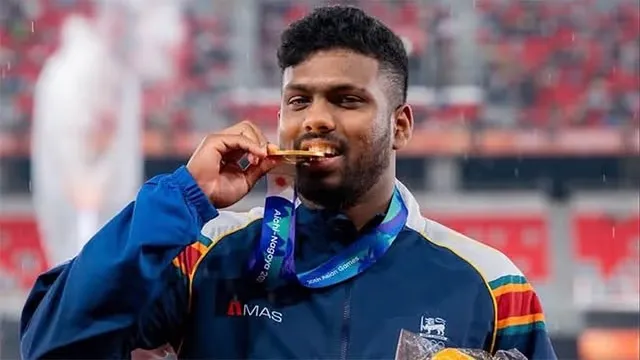
Rumesh Tharanga’s javelin triumph saves Sri Lanka from a dismal medal haul as questions mount over the cost and performance of the country’s biggest-ever Asian Games contingent.
Sri Lanka’s campaign at the 20th Asian Games in Aichi-Nagoya, Japan, has sparked fresh questions over the country’s sporting investment and international competitiveness after a contingent of 238 people returned with just one gold medal, alongside one silver and one bronze.
Despite fielding its largest-ever delegation for the continental sporting spectacle, Sri Lanka finished 28th in the medal standings, with javelin thrower Rumesh Tharanga emerging as the country’s sole gold medallist and the standout performer of the campaign.
Tharanga’s achievement in the men’s javelin throw provided a rare bright spot in an otherwise disappointing outing. Sri Lanka’s remaining medals came from the women’s T20 cricket team, which secured silver, and the men’s T20 team, which claimed bronze.
The men’s cricket team’s podium finish also marked Sri Lanka’s first medal in the men’s cricket competition since the 2014 Incheon Asian Games, when the country won gold.
However, the modest medal return has raised concerns about whether the scale of Sri Lanka’s participation translated into results worthy of the investment.
According to reports, the Sports Ministry incurred more than Rs. 100 million in expenses for the delegation, which included athletes and officials. The reported expenditure has prompted questions about athlete preparation, resource allocation and the effectiveness of the country’s high-performance sporting programmes.
Sri Lanka sent 156 athletes to Japan, comprising 100 men and 56 women, accompanied by 82 officials, including coaches, team managers, medical personnel and National Olympic Committee of Sri Lanka (NOCSL) staff.
The country competed in 25 sports, with athletics accounting for 24 athletes and cricket for 30, equally divided between the men’s and women’s teams. Other sizeable contingents included 18 hockey players, 13 rugby sevens players and 12 women competing in kabaddi.
Sri Lanka also fielded athletes in basketball, boxing, wrestling, beach volleyball, judo, badminton, weightlifting, squash and golf, alongside several other disciplines.
Yet, the breadth of participation did not translate into a broad medal-winning performance, leaving the country with a solitary gold and a finish outside the top 25 nations.
The result represents a decline from the previous Asian Games in Hangzhou, China, where Sri Lanka finished 26th with five medals one gold, two silver and two bronze. That performance was the country’s strongest overall medal return since the Busan Games in 2002.
Sri Lanka’s historical record at the Asian Games offers a stark contrast to its recent struggles. The country’s most successful gold-medal campaign came in Bangkok in 1998, when it secured three gold and three bronze medals, with Sugath Thilakaratne winning the men’s 400 metres and Damayanthi Darsha claiming gold in both the women’s 200 metres and 400 metres.
At the 2002 Busan Games, Sri Lanka won six medals, including two gold, one silver and three bronze. Susanthika Jayasinghe captured gold in the women’s 100 metres, while Darsha triumphed in the 400 metres.
The country also won six bronze medals at the 1966 Asian Games, demonstrating that Sri Lanka has previously enjoyed periods of greater success across its sporting disciplines.
Tharanga’s victory in Japan carried additional historical significance. He became the first Sri Lankan in 68 years to win an Asian Games medal in a field event, following the late Dr. Nagalingam Ethirveerasingam, who captured gold in the high jump at the 1958 Tokyo Games.
Returning to Japan, Tharanga thus revived memories of one of Sri Lanka’s landmark achievements in Asian athletics and underlined the importance of individual excellence amid the country’s broader struggles.
Historically, Sri Lanka’s Asian Games gold medals have come through athletics and cricket, while silver and bronze medals have also been won in disciplines including golf, boxing, tennis, windsurfing, cycling and karate.
The latest campaign, however, has renewed debate over the direction of Sri Lankan sport. With a record-sized delegation, substantial reported expenditure and participation across 25 disciplines, the limited medal return is likely to intensify scrutiny of how public funds are spent and how international success is measured.
Tharanga’s gold medal remains a significant achievement for Sri Lankan sport. But one athlete’s success cannot, by itself, resolve the wider questions surrounding preparation, investment and accountability.
For sports administrators and policymakers, the challenge now is to explain why a record contingent produced such a modest medal tally and what concrete changes will be made to ensure that future international campaigns deliver stronger results.